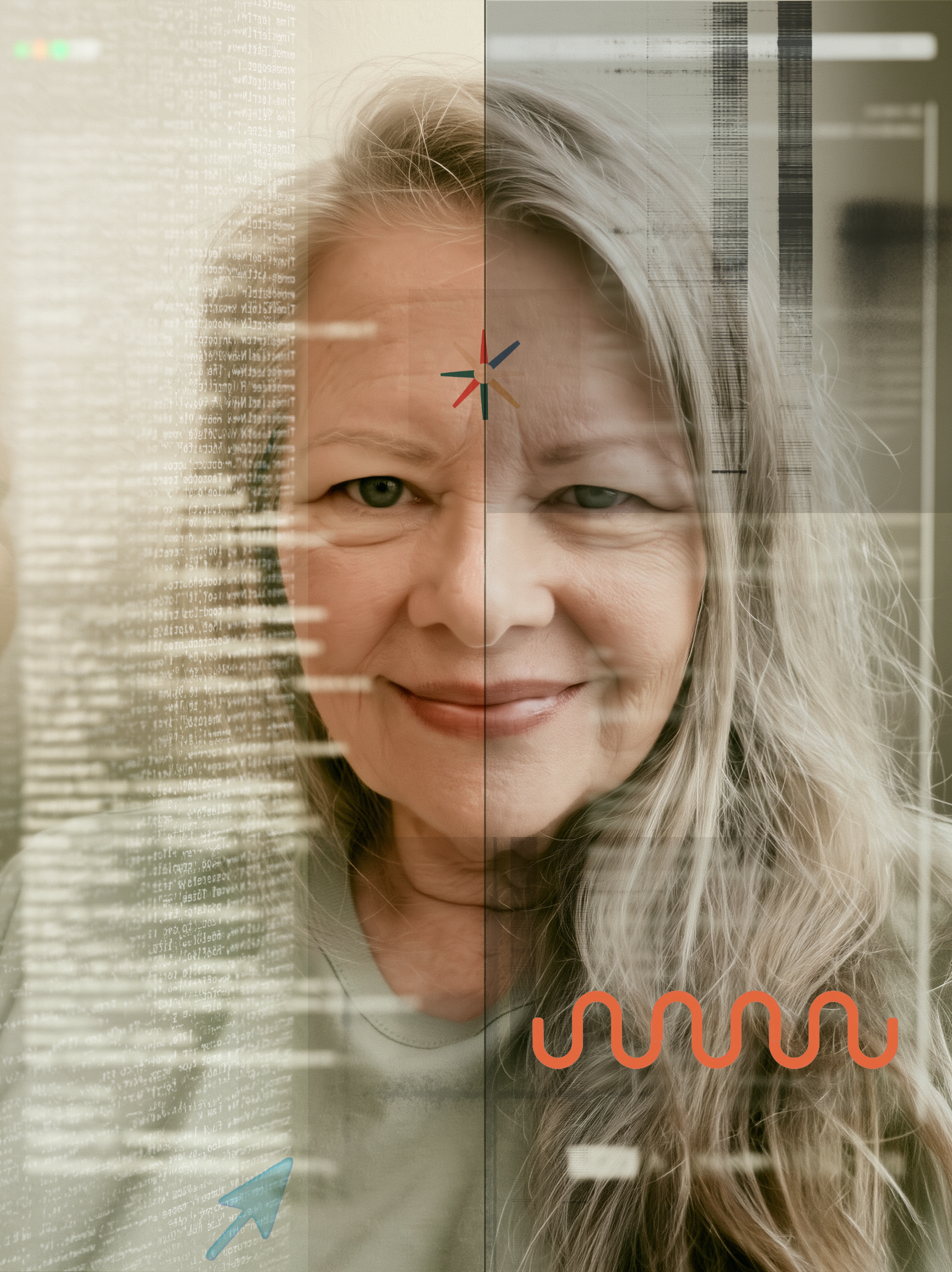
Thirty years ago, the internet was an unbroken wall of Times New Roman text. To navigate it, we relied on manual anchor links—rigid digital guideposts. By the early 2000s, UI/UX designers chased a new holy grail: natural language inquiry. We wanted to talk to our machines like humans.
Instead, the technology forced us to adapt to it. For decades, we trained ourselves to type in truncated keywords, manually code backend metadata, and build rigid frames to keep data contained. We treated metadata as a crutch for dumb machines.
Today, the loop is finally closing. The machine has learned to speak human.
We are witnessing two distinct design philosophies racing toward critical mass. On one side is OpenAI’s new voice interface—a highly stylized, conversational “companion” rebrand. It uses a friendly, cinematic persona designed to be a distinct entity you visit. It is the modern descendant of Ask Jeeves, finally given a real-time voice and a warm brand turn.
On the other side is Google’s Gemini. It rejects the standalone “friend” persona in favor of ambient infrastructure. Represented by a fluid, shifting starburst, Gemini isn’t a person you visit; it is an invisible ingredient baked directly into the tools we already inhabit—our documents, our search, our operating systems.
Just as Bluetooth evolved from a clunky, blinking headset into an invisible protocol connecting our physical environment, AI is transitioning from an external tool into ambient context.
Yet, as the mechanical friction is absorbed by the code, a more critical transition occurs. The ultimate guidepost is no longer the engineering framework, but human intent. Discernment is transforming from a passive observation into an increasingly intentional awareness.
This awareness is vital, not just for the technologist mapping out these digital architectures, but for the real-life considerations of navigating our daily lives. When the noise of the interface falls away, we are left with the only task that has ever truly mattered: the conscious, discerning quality of human presence.
Leave a Reply