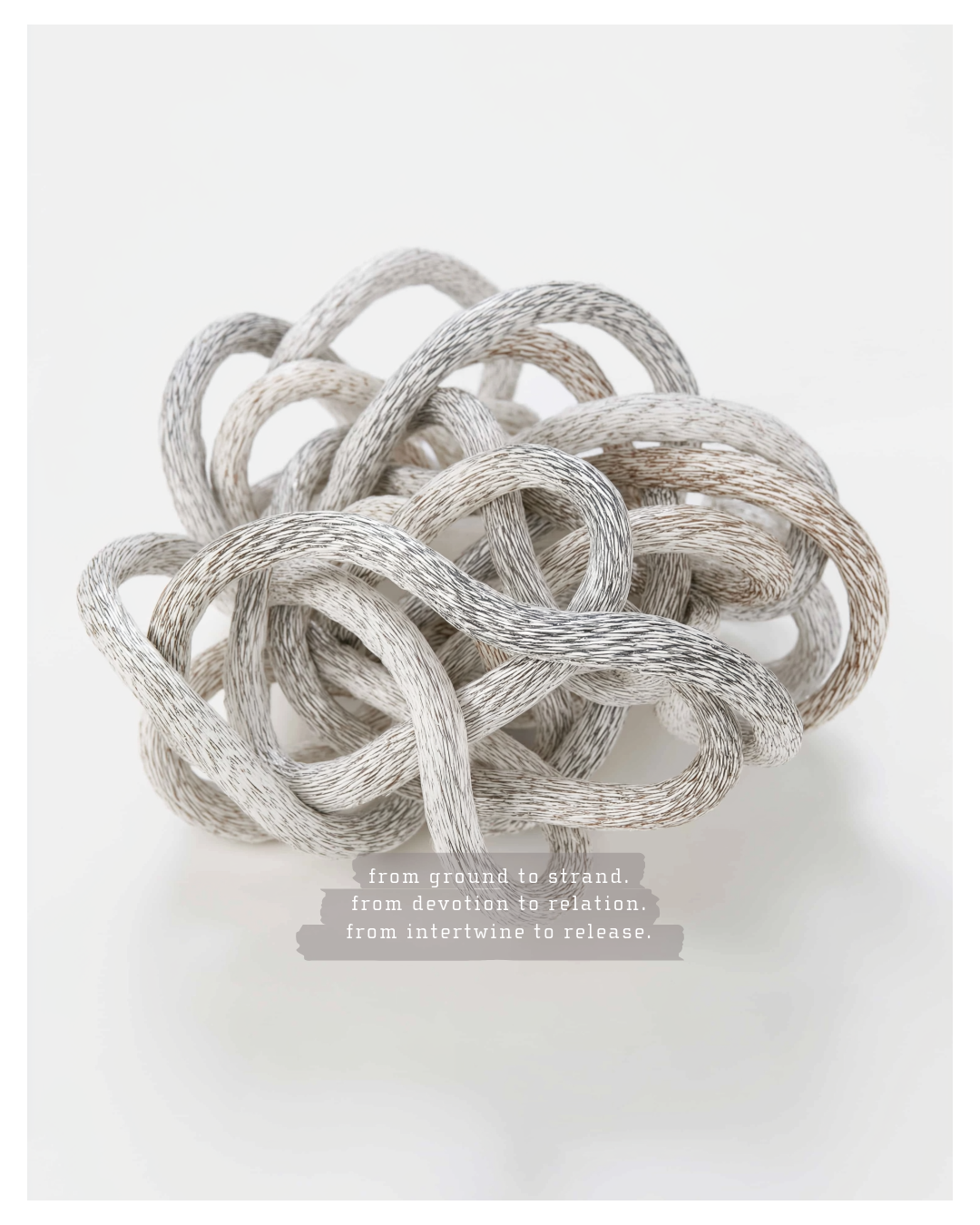
Intertwining begins where separation softens without disappearing.
A strand does not lose itself by passing over and under another strand. It remains distinct, but altered by relation. The form is made through contact: tension, yielding, return, repetition. Nothing here is fused.
Nothing is entirely free.
After the devotional ground, the strand rises. What was once a surface for orientation becomes a structure of relation. The body no longer simply kneels upon a field; it enters the knowledge that every field is already woven.
To intertwine is not to become indistinct. It is to accept that meaning is made through crossings.


“Prayer and Transcendence” Exhibition (George Washington University Museum & The Textile Museum)
This major exhibition systematically analyzes classical prayer carpets as physically created structures. It focuses on how iconographic architectural elements—like the mihrab arch—function fundamentally as universal gateways or psychological tools designed to alter human perspective. You can review their published virtual panels and symposium documentation to see how historians discuss the rug as a “sacred threshold”. Read details via the George Washington University Museum.
“Devotion: Religion and the Arts” Project (North Carolina Museum of Art)
An expansive digital and material educational asset examining how universal human creativity translates spiritual ritual into material practices. It looks deeply at the physical power of an object to engage human anatomy, capture concentration, and anchor individual or collective focus. Explore further on the North Carolina Museum of Art Learning Portal.
Art Historical Literature on Devotional Practice” Art and Devotional Imagery: Visual Cultures of the Sacred” (David Morgan)
Professor David Morgan is a primary authority on the intersection of fine art and material devotional practices. This text evaluates how physical, earthly visuals act as interfaces for meditation, breaking down the psychological shift that occurs when an individual engages deeply with a structured spiritual space. Research copies are accessible on ResearchGate.”
Early Netherlandish Paintings as Devotional Objects” (Journal of Historians of Netherlandish Art)
An extensive scholarly review trace-analyzing how paintings and tapestries historically functioned less as static illustrations and more as functional, material instruments of private or collective focus. It emphasizes that an object’s “devotional quality” stems entirely from its practical architectural and physical use. Read the full open-access study through the Journal of Historians of Netherlandish Art.
Concept and authorship with final editorial direction by Carolyn Parker.
Developed through a process of observation, image-making, writing, and critical dialogue. Midjourney, Adobe Creative Cloud, ChatGPT (OpenAI), and Google Gemini served as generative and analytical tools throughout the project. Primary source materials, interpretation, sequencing, and final editorial decisions by the artist.
Series available as works on paper or as a printed zine.
You must be logged in to post a comment.