When you look at a prayer rug, what do you see? For many in the West, the object immediately triggers a specific cultural slide-show: a religion, a geography, a geopolitical news cycle. For those unfamiliar with the practice, the rug can feel exclusive, localized, or even intimidating—a boundary marker separating “us” from “them.”
But if we strip away our immediate cultural projections and look at the object through the lens of human experience, a beautiful, universal truth emerges. A prayer rug is not an altar, and it is not a boundary. It is an instrument of orientation.
Long before it carries religious symbolism, a rug establishes a very basic human necessity: it marks a place for the body.
Every human culture across history has sought a way to separate ordinary space from “attended” space. We build thresholds. We clear forest floors. We lay down woven mats, yoga mats, tatami, and cushions. We do this because the human mind is easily distracted, and the human body requires grounding. When a person steps onto a designated surface, a psychological shift occurs. The chaotic noise of the world is momentarily bracketed out. The surface becomes a dedicated ground upon which attention might gather.
In this sense, the prayer rug is a universal architecture. It recognizes that to look inward, or upward, we must first look down. It acknowledges our physical vulnerability—providing a soft boundary between the human knee and the hard, cold earth.
When we view the intricate patterns on a traditional rug, we are not looking at exclusive dogmatic codes. We are looking at a field of return. The geometric grids, the symmetrical borders, and the central archways are visual tracks designed to pull a wandering eye back to a single focal point. They carry memory, discipline, and human signal. They are footprints of the universal human desire to remember who we are, to find our bearings in a dizzying universe, and to begin again.
To look at a prayer rug and see only a singular religious practice is to miss the broader tapestry of human devotion. Devotion is not a geography. It is a posture. Whether we kneel on wool, sit on a wooden bench, or stand on bare dirt, we are all using the physical world to anchor our internal lives.
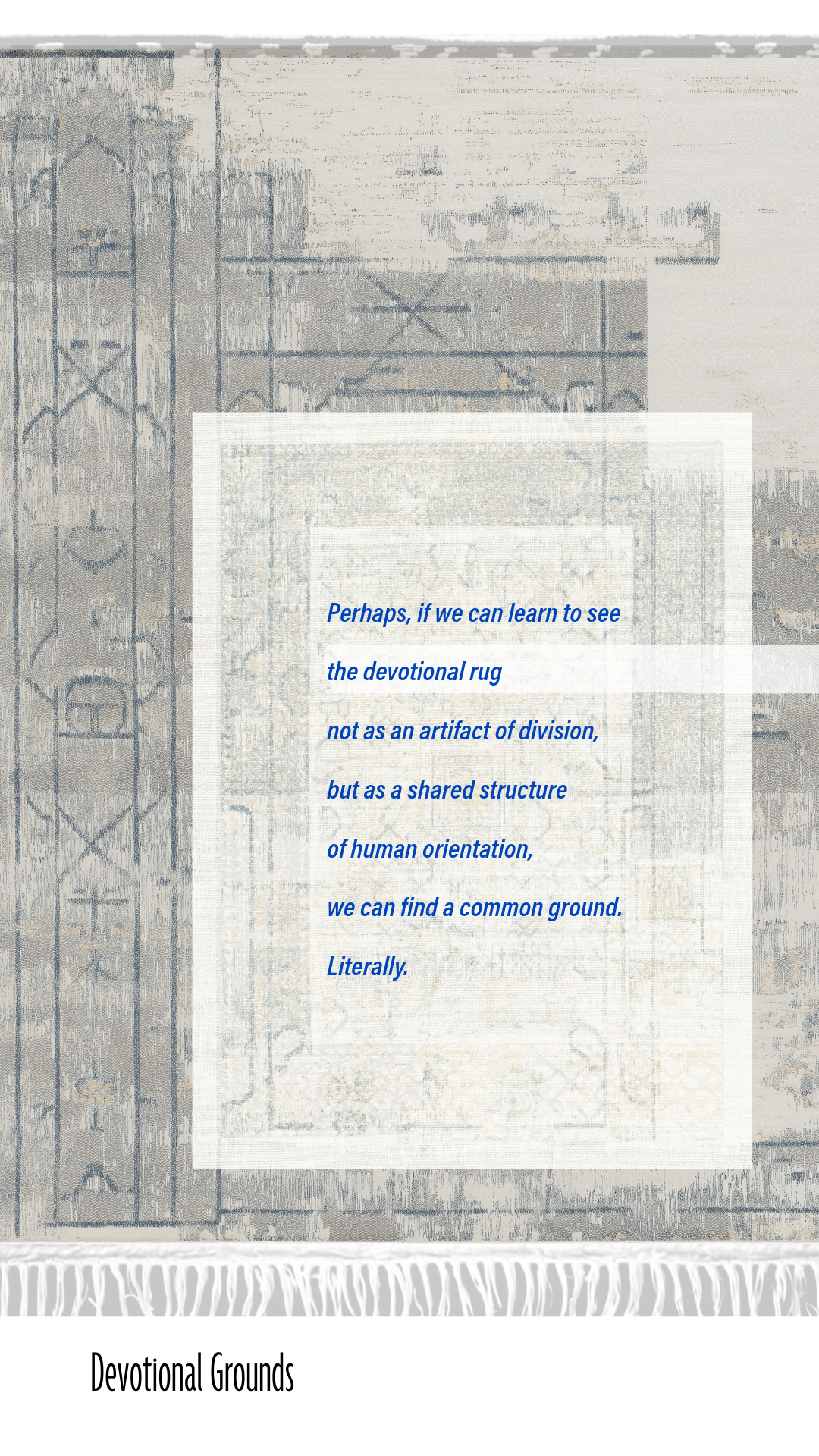
Perhaps, if we can learn to see the rug not as an artifact of division, but as a shared structure of human orientation, we can find a common ground. Literally. A place to kneel, a place to remember, and a place to breathe together.


“Prayer and Transcendence” Exhibition (George Washington University Museum & The Textile Museum)
This major exhibition systematically analyzes classical prayer carpets as physically created structures. It focuses on how iconographic architectural elements—like the mihrab arch—function fundamentally as universal gateways or psychological tools designed to alter human perspective. You can review their published virtual panels and symposium documentation to see how historians discuss the rug as a “sacred threshold”. Read details via the George Washington University Museum.
“Devotion: Religion and the Arts” Project (North Carolina Museum of Art)
An expansive digital and material educational asset examining how universal human creativity translates spiritual ritual into material practices. It looks deeply at the physical power of an object to engage human anatomy, capture concentration, and anchor individual or collective focus. Explore further on the North Carolina Museum of Art Learning Portal.
Art Historical Literature on Devotional Practice” Art and Devotional Imagery: Visual Cultures of the Sacred” (David Morgan)
Professor David Morgan is a primary authority on the intersection of fine art and material devotional practices. This text evaluates how physical, earthly visuals act as interfaces for meditation, breaking down the psychological shift that occurs when an individual engages deeply with a structured spiritual space. Research copies are accessible on ResearchGate.”
Early Netherlandish Paintings as Devotional Objects” (Journal of Historians of Netherlandish Art)
An extensive scholarly review trace-analyzing how paintings and tapestries historically functioned less as static illustrations and more as functional, material instruments of private or collective focus. It emphasizes that an object’s “devotional quality” stems entirely from its practical architectural and physical use. Read the full open-access study through the Journal of Historians of Netherlandish Art.
Concept and authorship with final editorial direction by Carolyn Parker.
Developed through a process of observation, image-making, writing, and critical dialogue. Midjourney, Adobe Creative Cloud, ChatGPT (OpenAI), and Google Gemini served as generative and analytical tools throughout the project. Primary source materials, interpretation, sequencing, and final editorial decisions by the artist.
Series available as works on paper or as a printed zine.
You must be logged in to post a comment.