For Christians unfamiliar with Jewish narratives, the first responsibility is humility: not to appropriate the Aggadot as “lessons for America,” but to receive them as particular Jewish memory that has something grave to teach any society willing to examine itself. The lesson is not “we are all the same.” The lesson is that every people has its own grain stores, its own banquet table, its own silent witnesses, its own zealots, and its own temptation to call destruction fidelity.
In fact, I see the same core thread running through Trump Truisms, State of the Union, and now this inquiry via the Aggadot of Destruction:
How societies break down from within — linguistically, morally, structurally — and what forms of attention, restraint, and witness might interrupt that decay.
That’s the throughline. Not partisan commentary in the shallow sense. Not religion as doctrine. Not history as illustration alone.
Rather, language becomes behavior; behavior becomes norm; norm becomes structure; structure becomes destiny. And our work and my focus keeps returning to the point where that process is still visible — where a culture is not yet fully collapsed, but is showing its fractures.
Context and Source Notes
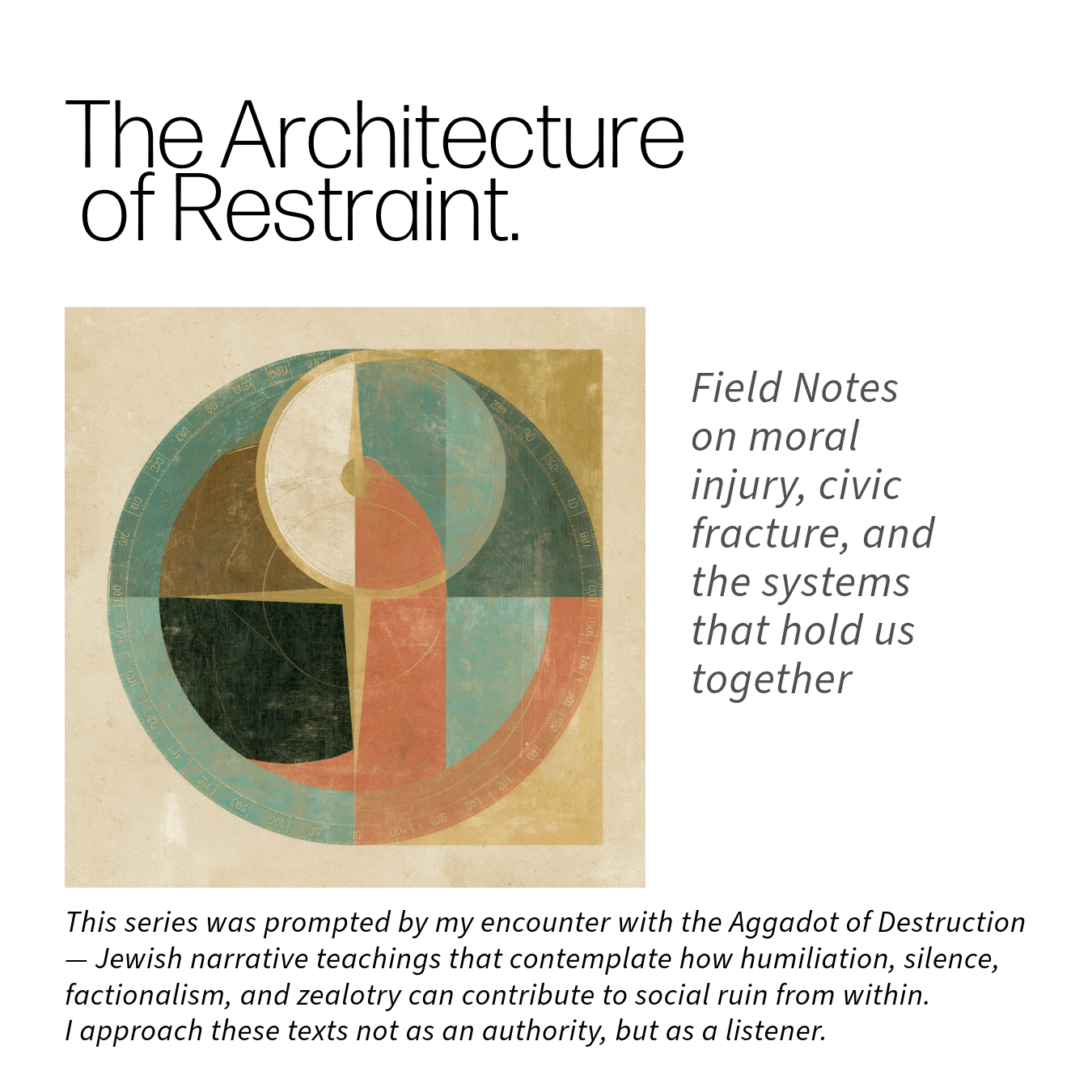
The Architecture of Restraint was prompted by my encounter with the Aggadot of Destruction — Jewish narrative teachings that contemplate how humiliation, silence, factionalism, and zealotry can contribute to social ruin from within.
I approach these texts not as a scholar, rabbi, or authority, but as a Christian-formed listener trying to receive a grave warning with humility.
The series does not attempt to merge Jewish and Christian belief, nor to convert Jewish memory into a universal slogan. Its premise is more restrained: particular histories must remain particular, but the moral dangers they reveal may still speak across communities.
The stories that shaped this work include the humiliation of Bar Kamtza at a banquet, the silence of respected witnesses, the hardening of leadership, and the burning of Jerusalem’s grain stores by zealots who preferred forced confrontation to survival. These are not merely ancient episodes. They describe recurring human behaviors: public humiliation, grievance, moral cowardice, factional purity, and the destruction of shared systems in the name of loyalty.
For me, the message is direct:
Pain is not permission.
Peace is structural.
Silence participates.
Destruction is not fidelity.
A people does not have to agree on everything in order to preserve what holds life together. Christians, Jews, and all communities shaped by memory, injury, and conviction may differ profoundly in belief and history. Yet all peoples face the same recurring danger: the temptation to mistake zeal for courage, grievance for righteousness, and destruction for faithfulness.
This series asks what must be refused before collapse becomes inheritance.


Babylonian Talmud, Gittin 55b–58a — Sefaria
Primary source text for the cluster of destruction narratives.
Gittin 55b–56a — Kamtza and Bar Kamtza / destruction of Jerusalem
Primary source passage for the banquet, humiliation, silence, imperial escalation, and beginning of the destruction sequence.
Kamtza and Bar Kamtza — Chabad.org
Readable retelling that includes the zealots burning the stores of wheat and barley.
Yeshivat Har Etzion — “The Carpenter’s Apprentice”
Contextual note describing Gittin 55b–58a as aggadot dealing with the destruction of the Second Temple and its aftermath
Schechter Institutes — “What happens when good people do nothing?”
Helpful contemporary framing that notes the custom of studying Gittin 55b–58a on Tisha B’Av.
Concept and authorship with final editorial direction by Carolyn Parker.
Developed through a process of observation, image-making, writing, and critical dialogue. Midjourney, Adobe Creative Cloud, ChatGPT (OpenAI), and Google Gemini served as generative and analytical tools throughout the project. Primary source materials, interpretation, sequencing, and final editorial decisions by the artist.
Series available as works on paper or as a printed zine.
You must be logged in to post a comment.